A Japanese snack box and a wagashi box are different products sold to the same person. A Japanese snack box is an assortment of packaged Japanese confectionery, mostly factory-made for retail sale and chosen for variety and long shelf life. A wagashi box is traditional Japanese confectionery, usually short-dated, usually made by confectioners rather than manufacturers. Both are legitimate. They are not interchangeable, and the difference comes down to one thing: water.
Wagashi box vs Japanese snack box: Quick comparison
| Japanese snack box | Wagashi box | |
| Typical contents | Packaged sweets, crackers, candy, tea; sometimes homewares | Traditional confectionery: monaka, yokan, higashi, manju |
| Made by | Manufacturers, mostly for the Japanese retail market | Confectioners, often in small batches |
| Shelf life on arrival | Weeks to months | Days to around two weeks |
| Number of items | 15 to 25 | Fewer, typically under 12 |
| What it is for | Trying many things; a parcel that keeps | Eating properly, usually with tea |
| Price | $32.50 to $37.50 a box plus $5.00 to $14.99 shipping (Sakuraco, September 2026) | Wagashi Bunka Classic, US$118, shipping from Japan included |
What is wagashi?
Wagashi (和菓子) is traditional Japanese confectionery, as distinct from yogashi (洋菓子), the Western-derived category of cakes, biscuits and chocolate. The word wagashi describes a tradition, not a quality tier. A mass-produced dorayaki from a convenience store is wagashi. So is a nerikiri shaped by hand into a chrysanthemum for a tea ceremony.
This is why “authentic wagashi” claims are almost impossible to evaluate from a product page. Almost anything sweet and Japanese can carry the word honestly. The useful question is not whether something counts as wagashi. The useful question is which part of the tradition you are being sold.
Types of wagashi: namagashi, han-namagashi and higashi
Japanese confectioners sort wagashi into three categories by water content. These categories are the working vocabulary of the trade, and they predict shelf life, texture, and whether a sweet can leave the country at all.
| Category | Water content | Traditional shelf life | Examples |
| Namagashi (生菓子) | 30% and above | Refrigerate, eat within a day | Nerikiri, daifuku, fresh yokan, dorayaki, manju |
| Han-namagashi (半生菓子) | 10% to 30% | Refrigerate, five to seven days | Monaka, castella |
| Higashi (干菓子) | 10% and under | One to three months | Senbei, rakugan, wasanbon |
Classification and shelf lives per the standard Japanese confectionery categories, as set out in Just One Cookbook, “Varieties of Wagashi” — link out to this, or to a Japanese-language source if you have one. Add the outbound link
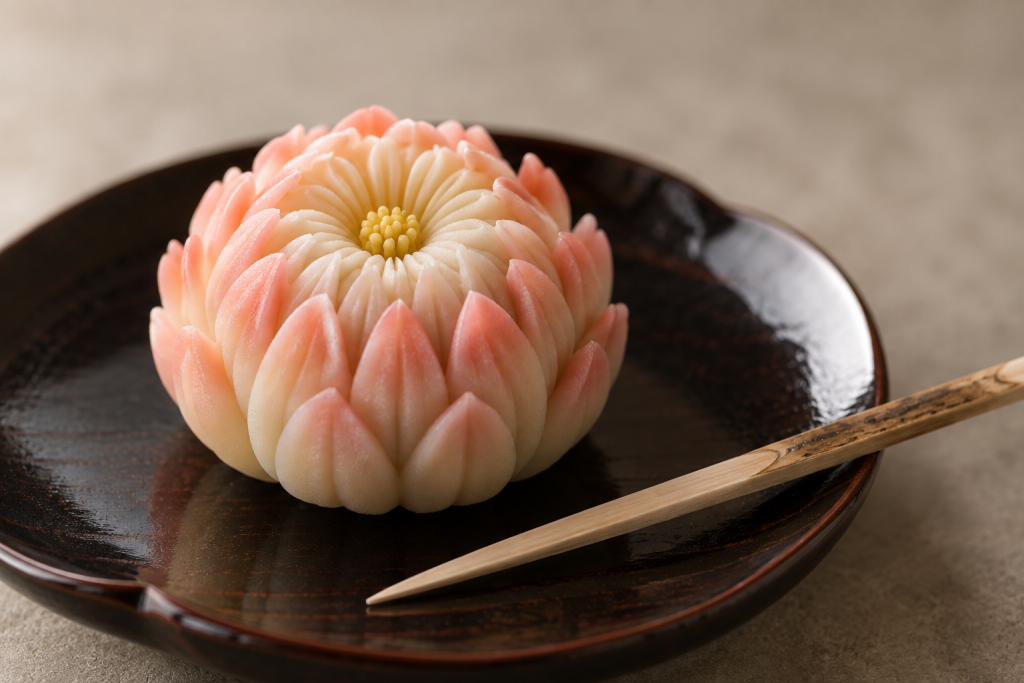
Namagashi is fresh wagashi at 30 percent water content or above, and it keeps for roughly one day. Namagashi is the wagashi in the photographs: the seasonal flowers, the translucent summer jellies, the pieces served alongside matcha in Kyoto. Namagashi is also, by definition, food that expires roughly tomorrow.
Higashi is dry wagashi at 10 percent water content or under, and it keeps for one to three months. Higashi is pressed, sugar-heavy and stable, real wagashi with real history, and it is what survives a container ship.
Han-namagashi sits between the two at 10 to 30 percent water content, keeping five to seven days refrigerated. Han-namagashi is where most exportable traditional confectionery lives.
One caution, because it matters when reading a product listing: industrial processing moves sweets between these categories. A commercially produced neri-yokan sealed for retail can keep for months, even though yokan sits in the namagashi column by tradition. The classification tells you what kind of sweet it is. The date printed on the package tells you what you are actually receiving. When the two disagree, believe the date.
Can you buy fresh wagashi outside Japan?
Fresh namagashi cannot be shipped internationally. No international subscription box delivers namagashi made the same week, Wagashi Bunka included, because namagashi made with fresh anko has a shelf life of roughly 24 to 48 hours, it is fragile enough that a firm grip damages it, and international parcels move in days.
Wagashi can still be bought abroad, in two forms. Retailers such as Minamoto Kitchoan ship wagashi internationally and run stores overseas, using sealed and shelf-stable preparations that keep for weeks or months. Separately, Japanese confectioners in large cities abroad make namagashi fresh on the premises, which is the only realistic way to eat true fresh wagashi outside Japan.
What crosses an ocean by post is the drier end of the tradition, plus short-dated items moving fast enough to arrive with time left on them. That is the honest ceiling for every box sold outside Japan. Sellers differ in how close to that ceiling they choose to work, because the closer you get, the harder the logistics and the smaller the margin for error.
A nerikiri made this morning in Kanazawa is a reason to go to Japan. It is not a thing you can order.
What is in a Japanese snack box?
Japanese snack boxes are monthly assortments of packaged Japanese confectionery, typically 15 to 25 items. The three largest are good at what they do, and it is worth being accurate about what that is. All details below are from each company’s published pages as of September 2026.
TokyoTreat leans modern. Limited-edition KitKats, seasonal convenience-store releases, drinks, savoury snacks, and items tied to current Japanese pop culture. TokyoTreat is not attempting to be traditional and does not claim to be.
Sakuraco is the box people mean when they ask whether a snack box counts as wagashi, and the answer is more interesting than yes or no. Sakuraco sends around twenty items per box on a monthly theme, and the mix does include traditional forms: mochi, manju, yokan, dorayaki, taiyaki and senbei, alongside tea, castella, madeleines and homewares such as ceramics or furoshiki. Sakuraco’s published pricing in September 2026 runs $37.50 a box on the one-month plan down to $32.50 on the twelve-month plan, plus $5.00 to $14.99 shipping depending on destination. Items arrive individually wrapped with moisture absorbers.
Individual wrapping and desiccants are the tell, and this is not a criticism. Wrapping each item and adding desiccants is exactly what you do to move twenty items across the world and have them all arrive intact. It also means the contents sit at the stable end of the moisture scale, because nothing else would survive the model. Twenty items, global shipping, and short-dated fresh confectionery cannot all be true at once.
Bokksu occupies similar ground to Sakuraco, with a stronger emphasis on regional makers and provenance storytelling.
None of these three are pretending to be something else. The confusion comes from further downstream: gift guides and roundups file every Japanese food box under one heading, so a reader looking for tea-ceremony sweets lands on a box of seasonal KitKats and concludes wagashi is not for them.
How to tell if a box is wagashi or a snack box
Five checks will separate a wagashi box from a Japanese snack box before you buy, in order of how much each one reveals.
- Find the shelf life. A shelf life stated in months means the contents sit at the dry, stable end. A shelf life in days or a couple of weeks means the box is closer to the living tradition. A shelf life published nowhere is itself information.
- Count the items. A box with more than 15 items is almost certainly a snack box, because short-dated confectionery cannot be assorted at that scale and still arrive with time left on it.
- Look for named makers. The phrase “traditional Japanese sweets” is a description anyone can write. A named confectioner in a named town is a claim that can be checked, which is why sellers who have it tend to print it.
- Read past the hero image. The seasonal nerikiri in the photograph is frequently illustrative rather than something in the box. Match the photograph against the written item list.
- Check whether it is a subscription. Recurring billing with a cancellation window is a different commitment from a one-off purchase. Both are fine. Knowing which one you clicked is the point.
Should you buy a wagashi box or a snack box?
Buy a Japanese snack box if you want variety, if you are shopping for someone whose interest in Japan is broad rather than specific, if the recipient is a child or a teenager, or if you want a parcel that arrives and keeps. On price per item, a snack box beats a wagashi box comfortably.
Buy a wagashi box if you drink matcha or sencha and want something made to accompany it, if you are interested in the confectionery as a craft, if you would rather have six things you will remember than twenty you will graze, or if you are giving a gift to someone who will recognise the difference.
The failure mode is buying one while expecting the other, and that happens because the two are described identically in most places a person would look.
What is in a Wagashi Bunka box?
The Wagashi Bunka Classic is a box of traditional Japanese confectionery containing 8 pieces, priced at US$63.50 shipped directly from Japan. It carries roughly two weeks of shelf life on arrival and holds a mix of short-dated and shelf-stable pieces. There are fewer items than in a Japanese snack box. That is the trade we have chosen, not an oversight.
Wagashi Bunka is not a subscription. You buy a single box, with no recurring charge and nothing to cancel. Boxes leave Japan in one batch on the 20th of each month, so an order ships on the next 20th after it is placed.
And Wagashi Bunka cannot send you a nerikiri made this morning. Nobody can.
Frequently asked questions about wagashi boxes
What is the difference between a wagashi box and a Japanese snack box?
A Japanese snack box is an assortment of packaged Japanese confectionery, mostly factory-made for retail sale and chosen for variety and long shelf life, typically 15 to 25 items for around $30 to $40. A wagashi box is traditional Japanese confectionery, usually short-dated and made by confectioners rather than manufacturers, with fewer items at a higher price. The practical difference is shelf life: snack boxes keep for weeks or months, wagashi boxes for days to around two weeks.
Is Sakuraco wagashi?
Partly. Sakuraco includes traditional forms such as mochi, manju, yokan and dorayaki alongside tea, Western-style baked goods and homewares. The traditional items are genuine wagashi. They sit at the shelf-stable end of the tradition, because a twenty-item box shipped worldwide cannot hold fresh confectionery.
Is TokyoTreat wagashi?
Largely no, and TokyoTreat does not claim to be. TokyoTreat focuses on modern Japanese snacks, limited-edition candy and convenience-store releases rather than traditional confectionery.
Can you buy fresh namagashi outside Japan?
Not by post. Namagashi contains 30 percent or more water and is traditionally eaten within a day of being made, so it cannot survive international shipping. Retailers such as Minamoto Kitchoan ship wagashi abroad using sealed, shelf-stable preparations, and Japanese confectioners in large cities abroad make namagashi fresh on the premises. The second is the only realistic way to eat true fresh wagashi outside Japan.
How long does wagashi keep?
It depends on the moisture category. Namagashi, at 30 percent water content or above, keeps about one day refrigerated. Han-namagashi, at 10 to 30 percent, keeps five to seven days refrigerated. Higashi, at 10 percent or under, keeps one to three months. Commercially sealed products often keep longer than the traditional category suggests, so check the printed date.
Is Wagashi Bunka a subscription box?
No. Wagashi Bunka is not a subscription. Each box is a single one-off purchase with no recurring charge and nothing to cancel. Boxes leave Japan in one batch on the 20th of each month, so an order ships on the next 20th after it is placed.
Is wagashi vegan?
Often, but not reliably. The core ingredients of most wagashi are beans, sugar, rice flour, agar and kudzu, none of them animal products, and agar is used where a Western sweet would use gelatin. Some varieties contain egg, dairy or honey. Castella and dorayaki both contain egg, so check the individual item.
Is wagashi gluten free?
Some types are and some are not. Wagashi made from rice flour, beans and agar, such as daifuku, yokan and warabimochi, contains no wheat. Dorayaki, castella, manju and monaka wafers are made with wheat flour and are not gluten free. Check the individual item rather than assuming by category.
Can Japanese sweets be imported into the UK, EU or Australia?
Wagashi Bunka ships from Japan by Japan Post, and the customer is the importer. Rules differ by country and by ingredient, and they change. In the UK, biscuits, chocolate and confectionery are listed by the UK government as having no import restrictions, and most wagashi falls in that category. The EU restricts personal imports of products containing dairy from outside the EU, so items containing milk may be affected. Australia requires every food item to be declared on arrival or on the parcel.
We cannot give customs advice for your country, and this is not legal advice. Check your own government’s guidance before ordering, and contact us if you want the full ingredient list for a box so you can check it against the rules where you live.